Showing posts with label winter. Show all posts

Wednesday, January 11, 2012

My nest...

Well winter is finally starting to rear it's ugly, cold head. And that means it's really hard to leave my nest bed in the morning.

I sleep in the v-berth of Misty Rose. The v-berth is essentially a compartment in the pointy part of the boat toward the bow.

My v-berth has the holding tank beneath it (there is a wooden platform that acts as the "floor" of the berth completely surrounding the tank, don't worry, you'd never know). On top of the holding tank platform is my bed.

I used to be a simple, one-sheet, one-blanket girl and then I spent my first winter aboard. And then I got an electric blanket during my second winter. And during my second summer I sprained my ankle and acquired a large number of pillows with which I propped my swollen ankle.

And I never got rid of any of it.

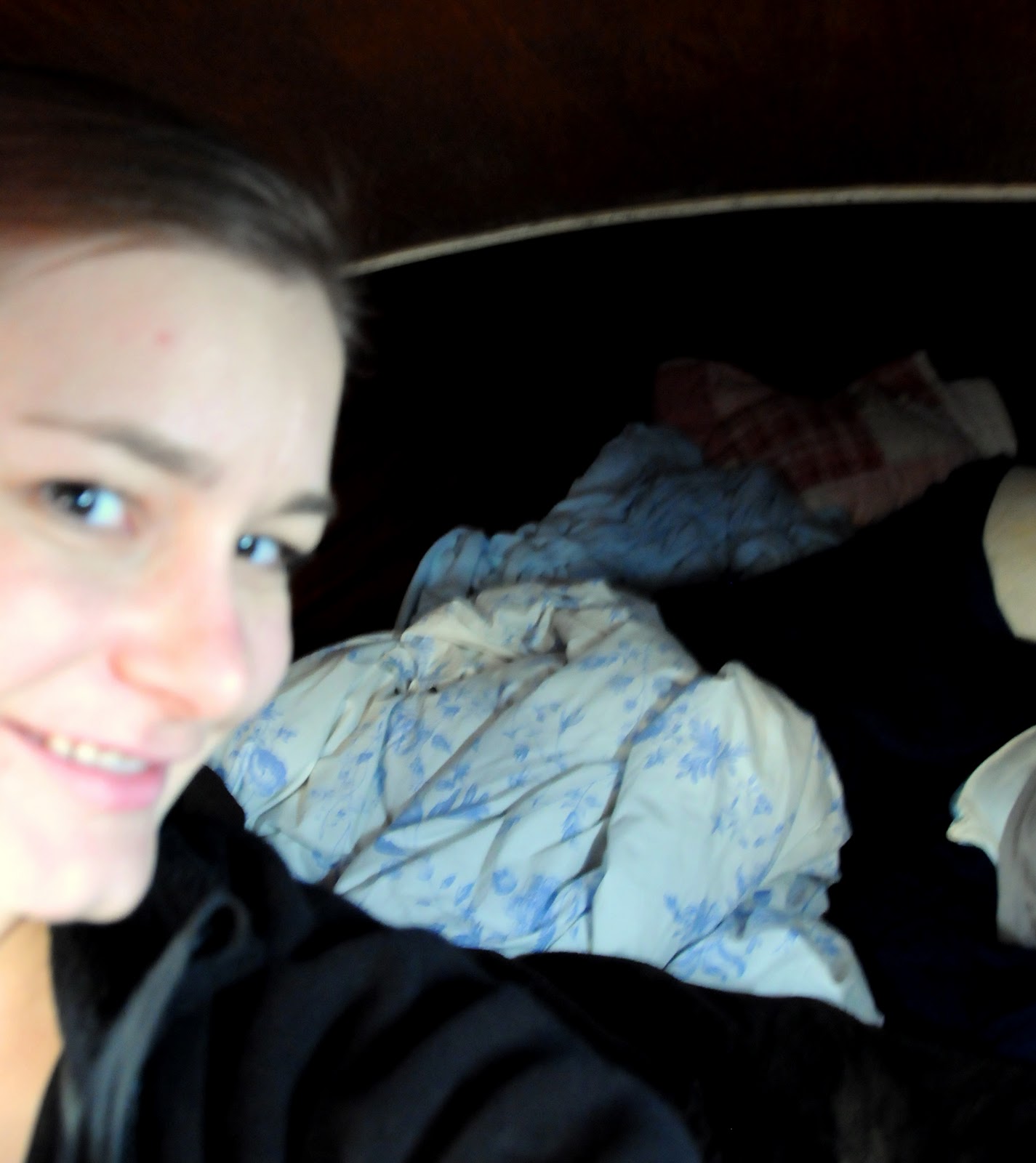
So what you see to the right here is my bed currently. Believe it or not, I had a couple more blankets last winter.

I won't apologize for the sheet not being fully tucked in. This is not a regular rectangular bed. You try making a triangular bed with a flat sheet and see how it turns out. So there.

Anyway, I've got in the back there the pink quilt I made in my sophomore year of college, a down comforter I bought in college, five or six pillows, a faux snuggie I carted in from the couch last night (it was cold!), my light cotton summer blanket and my beautiful and wonderful brown fuzzy electric blanket. That's its cord hanging down in the bottom left of the photo. And the cord on the right is very sneakily leading to my lamp/alarm clock. My Kindle is also hanging out on top of the lamp outside the frame. Along with about five half-drunk cups of water. Cause that's how I roll.

So for all you who want to know if it gets cold on the boat -- yes. Yes it does. But I can always just snuggle up in my bed and turn the electric blanket on high...


Monday, December 19, 2011

The end of procrastination...

Well I finally did it. I stopped putting off winterization. (Isn't that a weird word? One of the thousands of strange boat-isms)

Anyway. After attending my grandfather's funeral and wake on Saturday, Greg and I stopped by the boat to grab a couple of things and I happened to see Captain Phil of the Pintita, former boss and teacher of the USCG Captain's Course I took a couple winters ago. Capt. Phil is a STICKLER for early winterization, though to be honest it's only barely frozen overnight a couple of times this season. And with my boat in the water, it's not likely to freeze hard enough to crack the engine block anytime soon. But I'd purchased the antifreeze and I figured it was about well on time to get the antifreeze pumped through. And seeing the good Skipper lit a fire under me to be a prudent boater.

Luckily, winterizing my engine is a short procedure.

My engine, being an inboard diesel, is seawater cooled. It sucks water directly from the Bay, through a filter, and then around the engine to cool it when it is running. In the wintertime, if you don't replace this water with antifreeze, the water inside your engine can freeze and expand and crack your engine block. If you're keeping your boat in the water, you can wait a lot longer to winterize your engine because the water holds heat and until the water starts freezing, you don't really have to worry about this. If you store your boat on land in winter, you need to winterize for sure before removing your boat from the water.

Most boaters, including me, use potable antifreeze (which is pink, as opposed to antifreeze you use in your car, which is usually scarily green) for winterizing because you end up pouring an entire gallon of it directly into the Bay. On Misty, to winterize the engine, all I needed to do was fill a bucket with the pink stuff, unscrew the band holding the hose to the intake seacock (which I closed, thank you very much), pull the hose off, place the hose in the bucket 'o' antifreeze, and start the engine. Greg was quite helpful at this juncture. It's VERY difficult to get into and out of the engine access hole on Misty, so he was kind enough to fulfill my tool requests and watch the exhaust water to make sure it was turning fully pink.

And that's it! After the engine has sucked up a whole gallon of antifreeze and spat it out the back, all you need to do is reattach the hose.

Come spring (or a suitably warm winter day!) all you need to do is open the seawater intake seacock and start the engine and voila! Seawater cooling and antifreeze feeding the fishes.

Now if I could just muster the desire to fill my water tank so I can do some dishes tonight...

Friday, November 18, 2011

Gettin' cold...

Source
"Gettin' cold on the boat, isn't it?"

I hear this question several times a week from random co-workers, neighbors, marina staff, friends and various family members.

Another popular variation is: "So you live on a boat right? Isn't it, like, cold?"

Yes, yes it is.

"So what do you, like, do?"

The same thing you probably do -- I turn on the heat! I have two of these West Marine brand portable cabin heaters. I rarely use two, but every occasionally I get home late and it's cold. I also have a paranoia of breaking on in the middle of the night when it's 20 degrees out and freezing to death. Not like my parents live just 20 minutes away or anything. In the winter, my electricity bill runs about $130 a month for those who are curious. In summer, when I don't need a heater and the light lasts longer, it runs about $15 a month.

They retail for about $72, but you can usually find a $10-off coupon or a sale on these when it starts to get cold out.

The liveaboards I met last winter used traditional space heaters, but I have a paranoia about those as well. I have visions of them falling over and creating a fire in my beloved home. Fire aboard is one liveaboard experience I do not care to have. My little heater sits flat to the floor and could not possibly tip over. And I try to keep things off of the tables around it so that nothing falls in and burns. Starting a much-dreaded fire.

I blame my dad, by the way, for my fire paranoia. But in this case, I think it may be a healthy paranoia. According to the U.S. Coast Guard, in 2009 there were 5 deaths, approximately 130 injuries and more than $12,557,513 in damages from boat related fires in the United States.Youch!

I also, some of you longtime readers may remember, have an electric blanket that my parents' dog (you remember my father's secretary?) got me for Christmas last year. It is my favorite thing for banishing the cold quickly. Especially now that I work from home two days a week.

Add that to a nice warm waterproof winter coat, ski pants, Gore Tex gloves and snow boots, and I'm prepared to tackle just about any boat-related chore around.

Mind you, that doesn't mean I won't bitch about how cold it is from time to time. And it doesn't mean I won't impotently threaten to move into an apartment.

So, yes. It's gettin' cold on the boat. But this girl is prepared...

Monday, March 21, 2011

The arrival of an old friend...

Well, folks, today is the first day of spring, and I could not be any more giddy. (Well, maybe if it was 70 degrees outside and I had an old-fashioned Baltimore snowball in my hand...)

This was my first real winter aboard. I made it through the entire winter (with an occasional night at my parents' house or a friend's house) on Misty Rose -- and I lived to tell the tale! Last winter I wussed out and spent almost two months at my parents' house with blizzards and sickness. But this year, I managed to make it through. I didn't fall in and become a victim of the dreaded ice. No, readers, I made it with an electric blanket, two West Marine heaters, a down blaket, a faux Snuggie, some hiking socks and fleece pants, countless cups of tea and the kindness of the staff at Tidewater, who moved me to the sheltered dock close to the bathrooms for the duration.

Baltimore is starting to get warm, and you boaters out there know what that means -- work time!

Projects planned for my spring haulout include: replacing the floor inside the cabin salon, painting the bottom, painting the non-skid portions of the deck, re-varnishing the door boards, caulking the port holes, replacing some lines and cleats that aren't working well and, of course, going sailing!

Jeez, I'm tired just thinking about it all. Maybe we should stay with this whole winter thing for a couple more weeks...

Tuesday, February 1, 2011

Ice Part 2...

Ahoy there, bloggers! Well I've been diligently Dust Busting salt off my cabin floor, drawing up plans for spring work, working on my curtains and working on driving my dad nuts. It's all a lot of work, and it doesn't leave much time for blogging.

However, there was one more grain of wisdom about ice in marinas that I wanted to offer: Leave your swim ladder down.

I was perusing another liveaboard blog the other day and I realized that I am not the only person terrified of falling off the seawall or slipping on ice on the dock and falling in.

People have died falling in the water in winter and being unable to pull themselves out.

This has been a source of terror for me since I fell off the dock at the sailing center one January. At the time I was wearing a full foul weather suit, a fleece, sweatpants, sneakers, hiking socks a lifejacket and gloves. I stepped on a rotten piece of dock, lost my balance and fell straight into the water. With all that clothing on, I couldn't manage to pull myself onto the dock. Luckily, I had been sailing with my cousins and my dad and they pulled me out of the water.

Ever since then I've been scared that it will happen when I'm alone. To the point that I occasionally dream about falling in the water.

The simple solution? Leave your swim ladder down. If you, or someone else, falls in, at least the swim ladder will be there.

Other safety tips for not falling in? Don't pee off the back of your boat or the dock (a couple of years ago someone died that way). Always salt the ice on the dock. Maintain three points of contact on deck.

I guess this is a more serious entry than I normally write, but this is definitely something that freaks me out -- and it hadn't even occurred to me until recently to put my swim ladder down. So, folks, here's hoping you put your swim ladder down and stay safe for the rest of winter.

Thursday, January 13, 2011

Ice in the harbor...

People ask me all the time about keeping warm on the boat. All. The. Time. I don't mind, for the most part. Except when people flat out tell me I'm crazy. Which only happens two or three times a week, so it's all good.

And people wonder why I don't frequently tell people right away that I live aboard.

Anyway, one of the most frequently made assumptions about where I live (in the outer harbor in Baltimore) is that the water doesn't ice over.

Au contraire, readers, au contraire. It ices over constantly. It's been a cold, cold winter for the Chesapeake Bay, as evidenced by a huge fish kill of Spot.


It's difficult to see in this picture. I took it standing in the cockpit, facing out over the stern. I left the swim ladder in the picture so that you could see that it is in focus. The lines and ripples in the water are pieces of ice. (I had a surprisingly difficult time trying to capture the ice in a picture, so bear with me here.)

The marina where I live now doesn't have bubblers. A bubbler is a common piece of equipment in the Chesapeake Bay region and my marina in Washington, D.C., had them, as did my the marina in Pasadena, Md. Marinas use them to aerate the water around a dock. If ice freezes around pilings, the pressure can move the pilings. Marinas are always quite insistent that the bubblers are for the benefit of the dock and not the benefit of your boat -- liability issue I guess -- so some people buy them for their boats. I think this is a bit of a waste of money in the Bay.

Since I'm not in the Inner Harbor, the ice doesn't get too thick here. It gets just thick enough for ducks to sit on, but not so thick that it can't be easily broken with a stone. Not that I've tried that.

This brings me to the No. 1 rule for ice in marinas: Never break the ice around your boat.

You might ask why.

Well, I'll tell you.

Broken ice is quite sharp and can damage your hull if it's broken -- at least it will scratch a fiberglass hull and can even leave gouges. A lot of new boaters think they should break the ice -- this is wrong. Any good marina will send you lots of e-mails over the winter urging you to please, for God's sake, DO NOT BREAK THE ICE.

Living on the Potomac in D.C., the water iced over and stayed iced for most of the winter. My boat was fine.

Now I will admit, the sound of ice breaking at night or cracking against the hull in high wind is disturbing. But you must resist the urge to break the ice. Your boat (and your wallet) will thank you for it...


NOTE: If you live in a place where the ice builds up, buying a bubbler may be for you. For me, it's not necessary. The water doesn't ice over very thick here because the Bay is tidal and I live very close to open water.

Sunday, December 5, 2010

Winter's quiet night...

There's something I love about the marina at night in the wintertime. There's no one around -- no one I can see anyway. If anyone is here, they're hiding inside their boats, snug against the early winter breeze that takes your breath away. It's still and silent save the usual evening sounds.

There's the bell-like ringing of lines. The rhythmic thumping of halyards and the hollow echo of masts. The gurgle of water slapping the sides of the boats, the groan of compressed fenders and the ever-so quiet noise of lines stretching against their cleats. The quiet humming of rigging in the wind is louder than the traffic of the city half a mile away.

Then there's the noise of a working port. The occasional whistle of a tug or blast of a ship's horn as she prepares to leave port. That's the comforting promise that everything is running as it should, ticking away reliably in the background, bringing salt for the snowstorms, bananas and cars and potash and a million other things.

Of course there's also the long, almost harmonious, purr of rail cars blowing horns as they carry goods away from Baltimore. It is quiet and it's nice.

There's something quiet and comforting about the marina at night -- but it's most comforting from the warm, comfortable inside of a boat that has weathered more winters in her life than I...